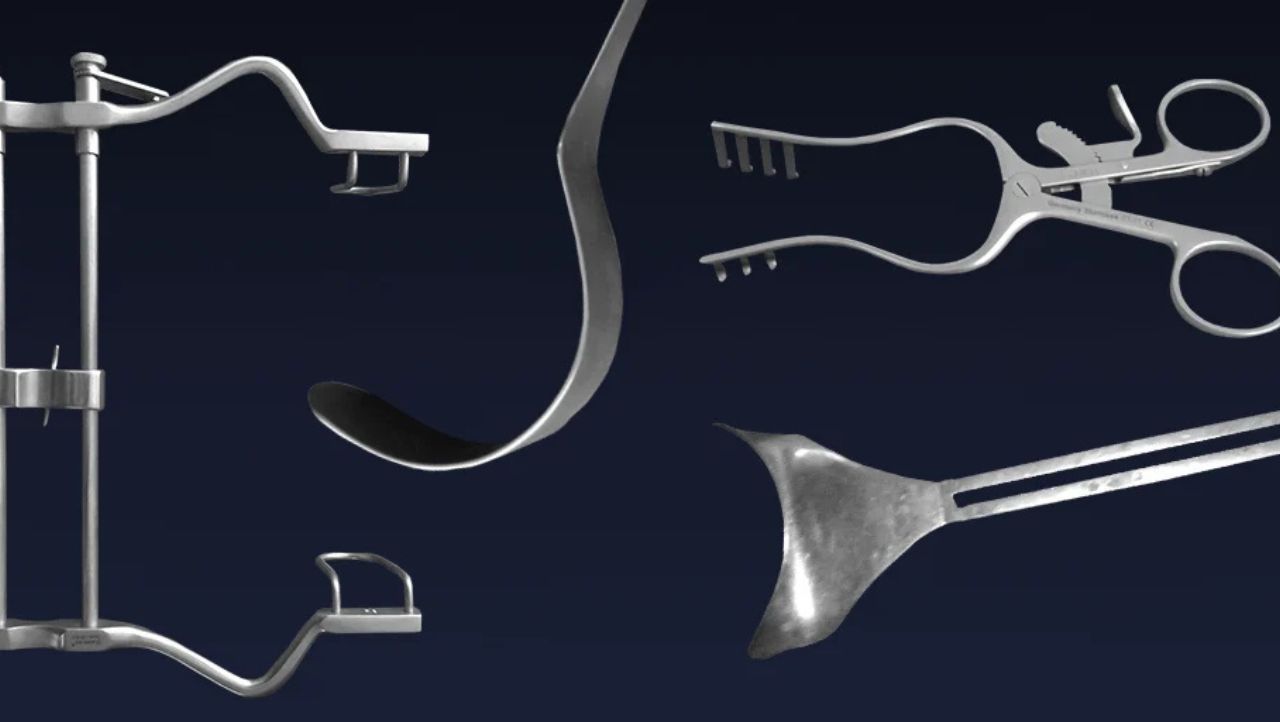
Types of Surgical Retractors: Names, Uses & Applications in Surgery
Surgical retractors are specialized surgical instruments used by surgeons and operating room professionals to hold an incision, wound, or tissue open during medical procedures. By pushing back underlying organs, skin, and muscles, these devices maximize visibility and provide deep, unobstructed access to the surgical site.
Dive through this comprehensive guide to explore more about a wide selection of retractors that exists today. Ranging from manual hand-held tools like the Deaver and Senn to self-retaining systems like the Balfour, each specifically engineered to match the anatomical demands of different surgical specialties.
What is Retraction and Exposure
In the modern operating theatre, successful clinical outcomes rely heavily on precision, control, and visibility. Surgical tools are fundamentally divided into four core functional categories:
- Cutting and dissecting
- Clamping and occluding
- Grasping and holding
- Retracting and exposing
Retractors come into the fourth category. Their primary role is to drive optimal exposure of the surgical site while mitigating trauma to surrounding anatomical structures.
Classification of Surgical Retractors
While hundreds of specialized variations exist across the global medical field, all retractors are broadly categorized into two main groups based on how they are operated during a procedure: Hand-Held (Manual) Retractors and Self-Retaining Retractors.
1. Hand-Held (Manual) Retractors
Hand-held retractors must be actively held in place by a surgical assistant, a nurse, or the surgeon throughout the duration of a specific procedural step. They offer exceptional flexibility, allowing the assistant to dynamically adjust the angle, depth, and force of retraction in real-time response to the surgeon’s changing movements.
2. Self-Retaining Retractors
Self-retaining retractors utilize mechanical locking mechanisms, such as ratchets, screws, clamps, or interlocking frames to remain open autonomously once positioned. By locking into place, these instruments keep tissues apart without requiring human intervention, effectively freeing up the hands of the surgical assistant and providing a perfectly stable, unmoving field of view.
Hand-Held Retractors and Their Applications
Manual instruments are highly versatile and are chosen based on the depth of the incision and the delicacy of the target tissue. Let’s know more about the most common hand-held models utilized across general and specialized surgeries.
1. Senn Retractor
The Senn is a double-ended, hand-held tool featuring a flat, smooth blade on one end and a three-pronged rake (which can be sharp or blunt) on the other.
- Primary Uses: It is primarily utilized to retract surface-level dermal layers and superficial tissues.
- Surgical Applications: Widely employed in plastic and reconstructive surgery, small bone and joint procedures, thyroidectomies, and fine dissections of delicate neck tissue.
2. Army-Navy Retractor
This highly recognizable instrument is a double-ended, flat metal bar with right-angle blades of differing lengths on each end. It is designed to minimize tissue slippage.
- Primary Uses: Used to retract shallow, superficial incisions and subcutaneous tissue layers.
- Surgical Applications: A staple in general surgery kits, ranging from minor wound closures to the initial abdominal wall incisions before deep retractors are placed.
3. Ribbon (Malleable) Retractor
Crafted from soft, highly flexible stainless steel or specialized alloys, the Ribbon retractor can be manually bent, twisted, and shaped by the surgical team into virtually any configuration.
- Primary Uses: Designed to safely retract deep, irregular wounds and safeguard delicate internal organs from adjacent sharp instruments.
- Surgical Applications: Frequently deployed in deep abdominal and pelvic surgeries, where it can be custom-contoured to cradle the liver, intestines, or bladder.
4. Hohmann Retractor
The Hohmann features a distinct, leaf-like blade with a pointed tip that leverages against bone to pull back overlying soft tissues.
- Primary Uses: Specifically built to expose bony structures while keeping muscles and blood vessels completely out of the operative field.
- Surgical Applications: Exclusively used in orthopedic surgery, including total hip and knee arthroplasties, fracture fixations, and bone grafting procedures.
5. Farabeuf Retractor
A simple, classic double-ended L-shaped manual instrument, the Farabeuf is one of the oldest and most versatile designs available in the surgical repository.
- Primary Uses: Retracting small, shallow incisions where precise, low-profile exposure is required.
- Surgical Applications: Deployed across a vast spectrum of fields, including oral and dental surgeries, wrist and hand procedures, and superficial inguinal hernia repairs.
6. Meyerding Retractor
Characterized by a deep, solid blade that often features a serrated edge or a lip at the tip to securely grip muscle tissue without slipping.
- Primary Uses: Designed to exert heavy, sustained traction on dense muscle masses flanking bony pathways.
- Surgical Applications: Predominantly used in spinal procedures, neurosurgery, and laminectomies to maintain clean exposure of the vertebral column.
7. Deaver Retractor
A large, curved hand-held tool shaped resembles a question mark or a sweeping arc, available in various widths.
- Primary Uses: Designed specifically for deep, heavy retraction of large internal organs within major body cavities.
- Surgical Applications: Crucial in thoracic and open abdominal procedures. For example, it is used during a cholecystectomy to elevate the right lobe of the liver, and during a truncal vagotomy to safely hold back the left lobe of the liver.
8. Richardson Retractor
Featuring a distinct, ergonomic loop handle and a deep, right-angled concave blade, this is one of the most widely used manual retractors in global medicine.
- Primary Uses: Holding back multiple, thick layers of deep tissue and fascial planes.
- Surgical Applications: Standard in open abdominal laparotomies, appendectomies, and major chest wall incisions.
Self-Retaining Retractors and Their Applications
When an operation requires prolonged exposure or highly complex, multi-axis visibility, self-retaining systems are deployed to establish structural stability.
1. Weitlaner Retractor
A scissor-like instrument featuring a self-locking ratchet mechanism and outward-curving prongs (either sharp or blunt) at the working tips.
- Primary Uses: Maintaining constant, hands-free separation of small-to-medium incision margins.
- Surgical Applications: Highly popular in basic plastic surgery, vascular procedures (like femoral artery exposures), and large bone or joint surgeries where superficial exposure must be maintained over hours.
2. Balfour Abdominal Retractor
A heavy-duty, multi-piece frame system consisting of two lateral wire blades that slide along a central bar, paired with a central bladder blade attachment.
- Primary Uses: Providing massive, multi-directional lateral and inferior exposure of the entire peritoneal cavity.
- Surgical Applications: The definitive instrument for deep open abdominal surgeries, major laparotomies, gynecological staging, and exploratory trauma surgeries.
3. Finochietto Rib Retractor
Commonly referred to as a rib spreader, this robust instrument features a heavy-duty crank handle and a geared track that forcibly separates ribs.
- Primary Uses: Spreading and holding open the intercostal spaces of the thoracic cage against the strong resistance of the ribs and chest wall muscles.
- Surgical Applications: Essential in thoracic surgery, open-heart operations, lung resections, and lateral thoracotomies.
4. Hip Retractor System
A specialized assembly comprising an adjustable rigid frame, multi-angle arms, and a collection of custom bone-leverage blades.
- Primary Uses: Frees up operating room assistants by maintaining stable, rigid, high-tension exposure around deep joint capsules.
- Surgical Applications: Maximizes visibility during complex hip arthroplasty, total hip replacements, and internal fixation of acute hip fractures.
5. Gelpi Retractor
A compact, scissor-style instrument with single, sharp, outward-pointed tips that dig slightly into tissue margins to prevent slippage, locked via a precise ratchet.
- Primary Uses: Retracting narrow, deep, or shallow wounds within constrained anatomical spaces.
- Surgical Applications: Universally utilized in spinal surgeries, orthopedic exposures, and small-site perineal or neurosurgical operations.
Types of Spine Surgery Approaches
- Anterior Approach (From the Front)
- Posterior Approach (From the Back)
- Lateral Approach (On the Side)
Salwan Surgicare – Surgical Retractor Manufacturer in India
When precision, durability, and safety matter most in the operating room, healthcare institutions worldwide trust top-tier medical manufacturing.
As a surgical retractor manufacturer, we at Salwan Surgicare manufacture premium-grade instruments built to withstand the rigorous demands of modern healthcare environments. Visit Salwan Surgicare today to explore our advanced product lines, request tailored quotes, and equip your surgical teams with the tools required for operational excellence.
Frequently Asked Questions
Hand-held retractors require an assistant to manually maintain tension, while self-retaining retractors lock mechanically into place, allowing hands-free exposure of the surgical site.
Malleable Ribbon retractors are designed to be bent and custom-shaped manually, allowing them to safely fit unique patient anatomy and protect delicate organs.
The Finochietto rib retractor, or rib spreader, is the standard instrument used to separate ribs and maintain access during major thoracic surgeries.
Minimally invasive retractors access the spine through small incisions, minimizing muscle disruption, which results in less post-operative pain and faster patient recovery times.
Yes, many modern retractor systems feature integrated fiber-optic or LED lighting, projecting bright illumination directly into deep, dark body cavities during surgery.