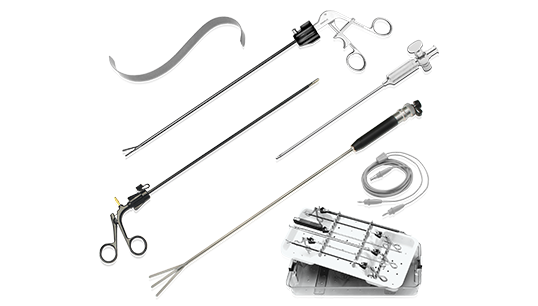
Laparoscopic Appendectomy Instruments: Complete Set List and Uses
Laparoscopic appendectomy is one of the most common minimally invasive abdominal operations. Surgeons remove the inflamed appendix through a few small ports instead of one larger incision, which usually means less pain, smaller scars, and a quicker return to normal activity. The operation is only as smooth as the instruments on the tray, though. A missing grasper or a poorly aligned pair of scissors can slow the case and add risk.
This guide lists the complete set of laparoscopic appendectomy instruments, explains what each one does, and gives practical advice for hospitals and distributors putting a set together. Salwan Surgicare manufactures a full range of laparoscopic instruments that cover every item below.
How a Laparoscopic Appendectomy Works: A Quick Overview
The surgeon creates a working space by inflating the abdomen with carbon dioxide, then places a camera port and two or three working ports. The appendix is identified, its blood supply (the mesoappendix) is divided, the base of the appendix is secured and cut, and the specimen is removed in a retrieval bag so it does not touch the wound. Ports are then closed. Each stage calls for a specific group of instruments, which makes it easy to build the tray in the same order as the operation.
Complete Laparoscopic Appendectomy Instrument List
1. Access and Entry Instruments
- Veress needle: used in the closed technique to create the pneumoperitoneum before the first port goes in.
- Hasson trocar: used in the open entry technique, placed under direct vision through a small incision at the umbilicus.
- Trocars and cannulas: a 10 mm or 12 mm port for the camera and larger instruments, plus one or two 5 mm trocars for working instruments. Reducers help when switching instrument sizes through one port.
2. Visualisation
- Laparoscope: a 10 mm, 30-degree telescope is the usual choice because the angled view helps the surgeon see around the cecum and into the pelvis. See Salwan’s endoscopes for optics options.
- Light cable, camera head and insufflation tubing: supporting equipment connected to the light source, camera system, and CO2 insufflator.
3. Grasping and Dissecting Instruments
- Bowel grasper: an atraumatic grasper for handling the cecum and small bowel without crushing tissue.
- Maryland dissector: curved jaws for fine dissection around the appendix and mesoappendix.
- Babcock grasper: broad, fenestrated jaws for holding the appendix itself gently.
- Right angle grasper: useful for passing behind a retrocecal appendix or creating a window through the mesentery.
The full graspers range includes other jaw patterns that surgeons may prefer for specific cases.
4. Cutting and Energy Instruments
- Laparoscopic scissors: curved or straight scissors for dividing the appendix once it has been secured.
- Hook or spatula electrode (monopolar): for dividing adhesions and the mesoappendix with electrosurgery.
- Bipolar grasper: for coagulating the appendicular artery and small vessels under controlled energy.
5. Securing the Appendix and Vessels
- Clip applicator: places clips on the appendicular artery or on the appendix base.
- Pre-tied loop (endoloop) and its introducer: a common alternative for ligating the appendix base.
- Linear stapler: used by some surgeons for the base in more complicated cases.
6. Suction, Irrigation and Retrieval
- Suction and irrigation cannula: clears pus and fluid and washes the field, which matters most in perforated or complicated appendicitis. Browse the suction tubes and cannulas range.
- Specimen retrieval bag: keeps the infected appendix away from the abdominal wall during removal and lowers the risk of port-site infection.
7. Closure
- Laparoscopic needle holder: for suturing the fascia at larger port sites.
- Open-surgery backup: a basic open tray (forceps, scissors, needle holder, retractors) should be available in the room in case conversion is needed.
Need a Complete Laparoscopic Appendectomy Set for Your Hospital?
CE-certified trocars, graspers, scissors and clip applicators, assembled to your protocol.
EXPLORE LAPAROSCOPIC INSTRUMENTS
Quick-Reference Table: Instrument and Purpose
| Stage | Key instruments | Purpose |
| Entry | Veress needle, Hasson trocar, trocars | Create pneumoperitoneum and ports |
| Visualisation | 30-degree laparoscope, camera | View the operative field |
| Exposure | Bowel grasper, Babcock grasper | Hold bowel and appendix safely |
| Dissection | Maryland dissector, hook electrode | Divide mesoappendix |
| Securing | Clip applicator, endoloop, stapler | Close the appendix base |
| Cutting | Laparoscopic scissors | Divide the appendix |
| Clean-up | Suction-irrigation, retrieval bag | Clear the field and remove the specimen |
| Closure | Needle holder, suture | Close port sites |
Typical Port Layout and Which Instruments Go Where
Most surgeons use a three-port technique. A 10 mm port at or near the umbilicus carries the camera. A 5 mm port in the left lower abdomen usually holds the grasper that retracts the cecum and appendix, and a second 5 mm or 10 mm port, often suprapubic, carries the dissector, scissors, clip applicator, or loop. Because surgeons sometimes swap instruments between ports, it helps to keep both 5 mm and 10 mm versions of the key items, along with a reducer, on the tray.
Extra Instruments for Complicated Appendicitis
When the appendix is perforated, gangrenous, or surrounded by an abscess, the case is harder and the tray should grow with it. Plan for a second atraumatic grasper to hold inflamed tissue, a high-flow suction and irrigation system to wash out pus, a stapler or additional pre-tied loops if the appendix base is friable, and a drain that can be placed through a port site. Some teams also keep a larger retrieval bag ready for a bulky specimen. Having these items open or immediately available avoids delays when the operative findings turn out worse than expected.
Practical Tips for Building the Set
- Match shaft size to ports. Most working instruments are 5 mm, with a few 10 mm items. Confirm every instrument fits your trocar and reducer set before you finalise the tray.
- Keep spares of high-wear items. Scissors and clip applicators wear faster than graspers, so many teams hold a spare of each.
- Check insulation on energy instruments. Damaged insulation can cause stray burns, so inspect the shaft before and after every case.
- Standardise the tray. A fixed layout reduces set-up time and helps the scrub team find each instrument quickly.
- Plan reprocessing. Reusable laparoscopic instruments have lumens and moving parts that need careful cleaning, so follow the manufacturer’s instructions for use.
Reusable or Single-Use Laparoscopic Instruments?
Reusable stainless-steel instruments cost more at purchase but usually work out cheaper per case for hospitals with steady volume, and they produce less waste. Single-use items remove the reprocessing step and can suit low-volume sites or items that are hard to clean, such as retrieval bags. Many hospitals use reusable graspers, scissors, and needle holders and keep single-use items for consumables.
Why Choose Salwan Surgicare
Since 1997, Salwan Surgicare has supplied hospitals and distributors with CE-marked, ISO 13485:2016 certified surgical instruments made from medical-grade stainless steel. Laparoscopic sets can be customised to your protocol, with private label and OEM options for distributors, and every instrument carries a one-year quality guarantee. Explore the general surgery instruments range for the open-conversion backup tray.
Conclusion
A complete laparoscopic appendectomy set covers six jobs: entry, visualisation, exposure, dissection, securing the appendix, and closure. Build the tray around those stages, check size compatibility, and choose instruments that survive repeated sterilisation without losing alignment. A well-planned set keeps the operation moving and keeps patients safe.
Get a Custom Quote for Bulk Laparoscopic Instrument Orders
Consistent quality, export-ready packaging, and reliable supply for hospitals and distributors worldwide.
REQUEST A QUOTE