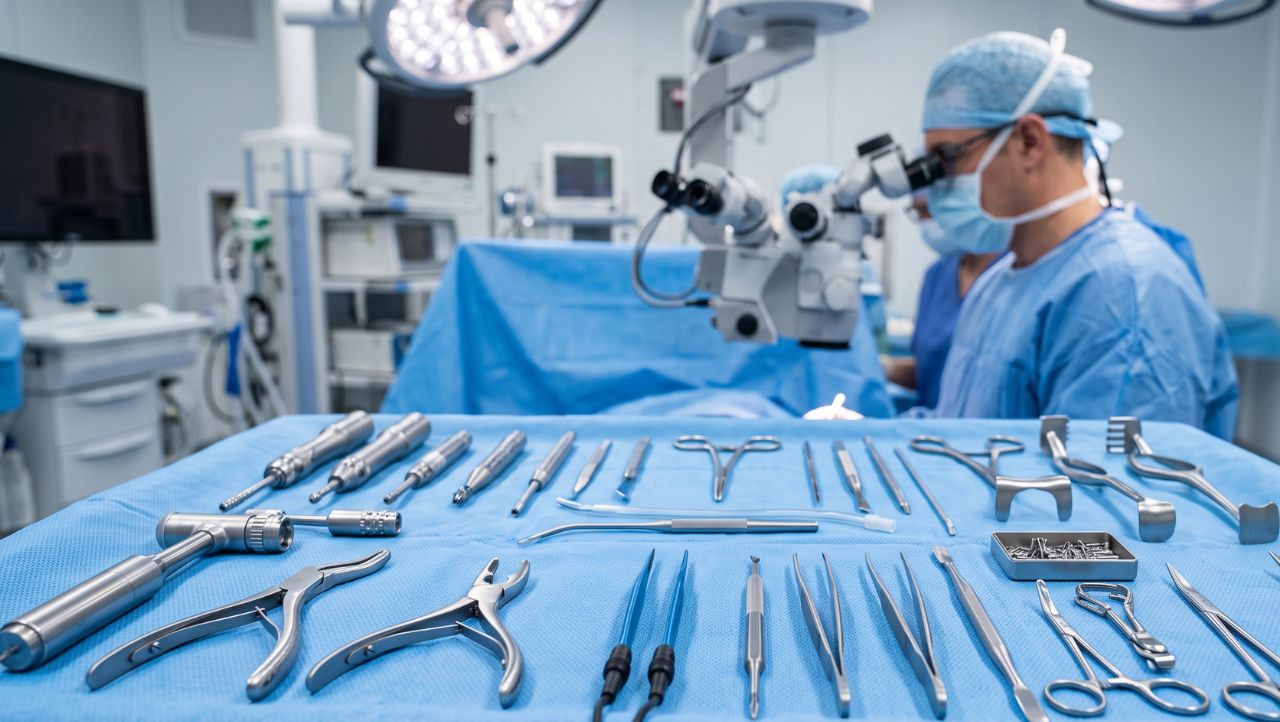
Neurosurgery Instruments Guide: Types, Names & Benefits
Neurosurgery requires absolute precision, making specialized neurosurgery instruments vital for successful surgical interventions targeting the delicate human nervous system. These advanced surgical tools allow neurosurgeons to safely navigate, manipulate, and operate on highly sensitive tissues within the brain and spinal cord without causing collateral damage. By utilizing high-grade materials and ergonomic engineering, these instruments minimize surgical risks, limit intraoperative bleeding, reduce hand fatigue during lengthy procedures, and significantly optimize overall clinical recovery outcomes for patients.
In this comprehensive guide, discover the essential types, distinct names, and clinical benefits of specialized neurosurgical instruments designed for optimal operating room performance.
What Are Neurosurgery Instruments?
Neurosurgery instruments are highly specialized, precision-engineered medical tools designed specifically for diagnosing, treating, and operating on the human nervous system. Since the brain, spinal cord, and peripheral nerves are delicate, these instruments are vastly different from standard surgical tools.
High-quality neurosurgical tools are crafted from medical-grade stainless steel or titanium alloys. Selecting tools from a certified neurosurgery instruments manufacturer ensures that the equipment withstands rigorous, repeated autoclave sterilization cycles without losing structural alignment, edge sharpness, or corrosion resistance.
Main Types of Neurosurgery and Their Required Tools
Neurosurgical interventions are categorized based on the specific anatomical zone and underlying pathology. Each branch demands a tailored subset of specialized tools:
- Neuro-Oncology (Brain Tumor Surgery): Demands highly precise microscopic scissors, curettes, and ultrasonic aspirators to meticulously resect tumors while isolating adjacent healthy parenchyma.
- Vascular Neurosurgery: Involves treating aneurysms and arteriovenous malformations (AVMs). It heavily relies on micro-forceps, temporary or permanent aneurysm clips, and highly responsive clip appliers.
- Spine Surgery: Covers laminectomies, spinal fusions, and discectomies. This specialty utilizes robust bone-cutting instruments like rongeurs, high-speed drills, osteotomes, and specialized spinal retractors.
- Functional and Stereotactic Neurosurgery: Used for deep brain stimulation (DBS) or movement disorders. This domain utilizes high-tech stereotactic frames, deep-brain electrodes, and real-time computer-assisted navigation systems.
- Pediatric Neurosurgery: Addresses congenital anomalies like hydrocephalus or craniosynostosis. It mandates scaled-down, ultra-delicate pediatric neurosurgical variants to fit smaller anatomical structures safely.
- Trauma Neurosurgery: Focused on emergency skull fractures or traumatic brain injuries (TBI). It requires immediate deployment of cranial perforators, drills, and heavy-duty bone elevators to rapidly relieve intracranial pressure.
Essential Neurosurgery Instruments Names and Uses
| Instrument Name | Primary Surgical Function |
| Scalpels & Specialized Blades | Making precise skin incisions and opening the dura mater |
| Perforators & Cranial Drills | Accessing the skull safely by drilling precise burr holes |
| Neurosurgical Rongeurs | Biting away dense bone and thick spinal soft tissues |
| Microsurgical Scissors | Dissecting minute nerves and micro-vessels under vision |
| Aneurysm Clips & Appliers | Occluding blood flow to prevent aneurysm ruptures |
| Surgical Curettes | Scraping and gently scooping out soft cystic lesions |
| Elevators & Dissectors | Separating delicate tissue layers without tearing them |
| Bayonet & Micro Forceps | Grasping fine tissue without blocking the line of sight |
| Self-Retaining Retractors | Holding tissue back automatically to free surgeon hands |
| Suction Tubes & Cannulas | Clearing blood and operative fluids to maximize clarity |
| Image-Guided Navigation Tools | Providing real-time CT/MRI mapping during deep surgery |
1. Incision and Access Tools
- Scalpels and Blades: Specialized scalpel handles with ultra-sharp micro-blades are critical for making clean entry cuts through the scalp and the tough outer protective membrane of the brain (dura mater).
- Perforators and Cranial Drills: Used to create precise burr holes in the skull during a craniotomy. Modern automated drills are engineered to stop rotating the instant they penetrate the dense bone, entirely protecting the underlying brain tissue.
2. Bone and Dense Tissue Management
- Rongeurs (Kerrison and Leksell): These are heavy-duty, sharp-edged biting tools designed to cut through dense bone or ligamentum flavum in the spine. They allow surgeons to create adequate structural windows or decompress pinched nerve roots.
- Elevators and Dissectors: Used to separate the periosteum from the bone or safely lift muscle layers away from spinal vertebrae without tearing sensitive soft tissues.
3. Micro-Dissection and Tissue Manipulation
- Microsurgical Scissors: Tiny, highly calibrated scissors used under an operating microscope. They feature straight, curved, or angled tips to safely cut micro-nerves and fine vascular structures during deep skull-base surgeries.
- Bayonet Forceps and Micro-Forceps: Characterized by a unique offset zigzag shape, bayonet style neurosurgery instruments names are famous because the handles stay out of the surgeon’s direct line of sight. This allows an unobstructed view down narrow surgical corridors.
4. Hemostasis and Field Maintenance
- Aneurysm Clips and Appliers: Tiny, biocompatible titanium clips placed permanently across the neck of a brain aneurysm to shut off its blood supply, effectively preventing life-threatening hemorrhagic strokes.
- Retractors (Leyla and Greenberg): These self-retaining retractor arms lock securely into place on the operating table frame. They apply constant, gentle retraction on brain or spinal tissue, allowing surgeons to work comfortably with both hands free.
- Suction Tubes and Cannulas: Fine-tipped, flexible suction devices that continuously evacuate blood, cerebrospinal fluid (CSF), and irrigation water. This ensures a clean, perfectly transparent surgical field at all times.
Benefits of High-Quality Neurosurgical Instruments
Investing in top-tier, precision-crafted neurological surgical instruments brings measurable advantages to the surgical team and the patient like:
- Maximizes Structural Accuracy
- Improves Patient Outcomes
- Reduces Physical Fatigue
- Extends Equipment Longevity
Request Neurosurgery Instruments PDF Catalogue
- Access our full, certified inventory of specialized premium surgical tools.
- Review detailed dimensions, structural variations, and custom titanium tool configurations.
- Discover high-precision forceps, durable rongeurs, and micro-scissors for operations.
- Streamline your hospital procurement process with standardized product ordering codes.
- Download the PDF catalogue instantly to explore world-class operating room equipment.
Elevate Your Operating Room Standards with Salwan Surgicare
The success of any intricate brain or spine surgery relies on the expert hands of the surgeon and the reliability of their neurosurgery instruments. Utilizing precision-engineered tools minimizes surgical margins of error and drastically boosts long-term patient safety.
Are you looking to equip your neurosurgery department with world-class, premium-grade surgical tools? Salwan Surgicare is an ISO 13485:2016 and CE-certified manufacturer and global exporter delivering elite medical instruments since 1997. We offer precision-manufactured instruments made from top-grade stainless steel, backed by an industry-leading 1-year guarantee against rust and breakage.
Explore Our Full Neurosurgery Catalog or Request a Custom Bulk Sourcing Quote Today!
Frequently Asked Questions (FAQs)
Frequently Asked Questions
The most common tools include cranial drills for burr holes, bayonet forceps for gripping tissue, micro-scissors for fine dissection, and self-retaining retractors to maintain open surgical visibility.
The offset, zigzag handle design of bayonet forceps ensures the surgeon’s fingers and the tool handles remain outside the direct visual path, maximizing visibility down deep, narrow surgical corridors.
Modern neurosurgical perforator drills feature smart automatic clutch mechanisms that sense a drop in structural resistance, instantly halting rotation the moment they completely pass through the skull bone.
Titanium is highly biocompatible, strong, non-magnetic, and corrosion-resistant. This ensures the permanent clip safely stays inside the patient’s body long-term without causing any adverse allergic reactions.
Self-retaining retractors lock firmly onto structural frames, maintaining steady, hands-free tissue retraction. This provides an undisturbed view while allowing the surgical team to utilize both hands for complex procedures.