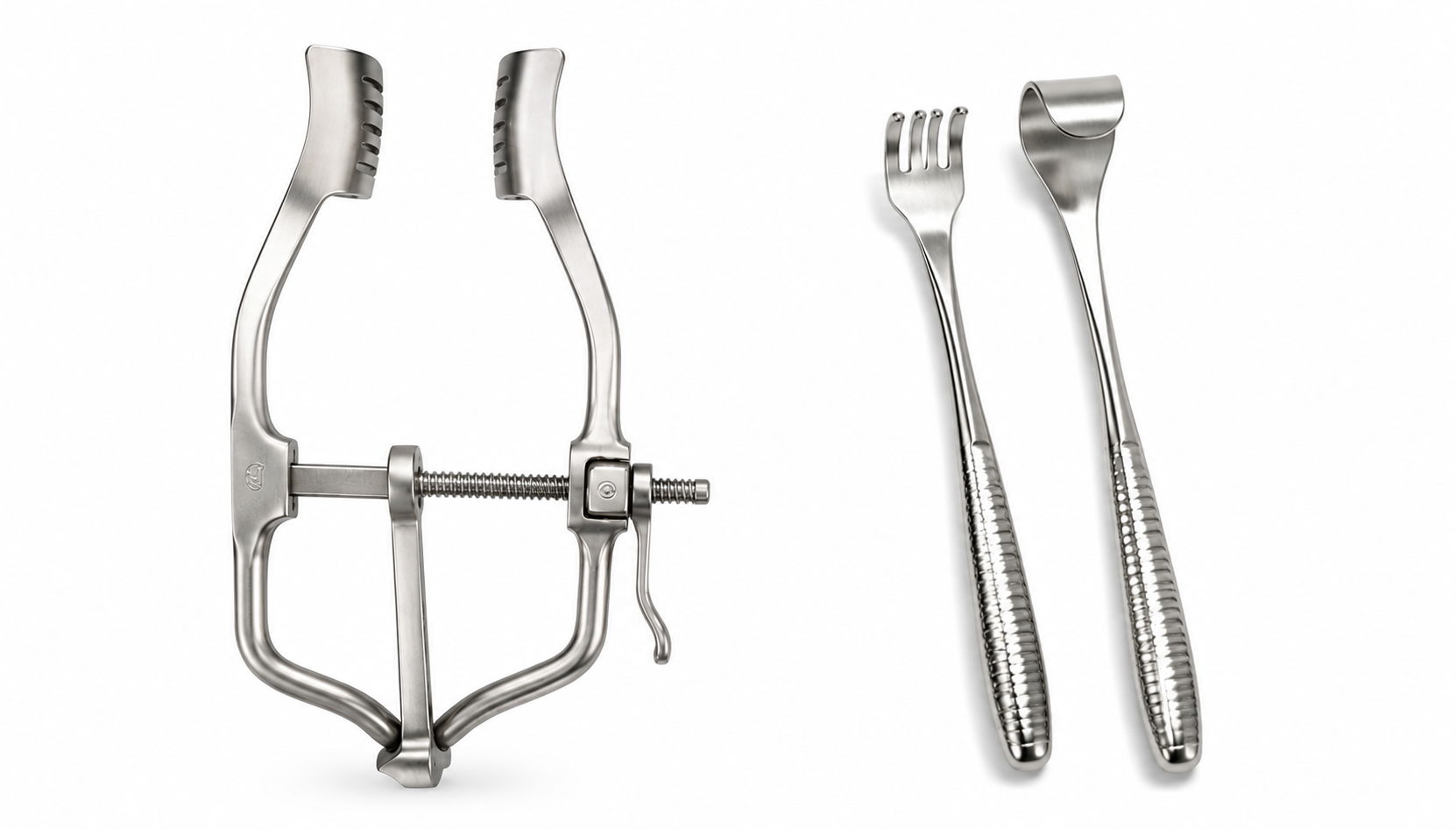
Self-Retaining vs Hand-Held Surgical Retractors: Differences, Uses and Which Is Better?
Every operation depends on exposure. When the surgeon cannot see the operative field clearly, every step that follows takes longer and carries more risk. Retractors carry that responsibility. They hold tissue, organs, and wound edges away from the working area so the team keeps a clear, stable view from incision to closure.
Two families of surgical retractors handle the job: hand-held and self-retaining. Picking the wrong one costs theater time, ties up staff, and can leave tissue under avoidable pressure. This guide covers how each type works, where each performs best, and how to choose between them.
What a Surgical Retractor Actually Does
A retractor keeps the surgical opening accessible. It separates skin, muscle, fascia, or bone and holds that separation while the surgeon works deeper, shielding surrounding structures from injury along the way. Blade shape, depth, and edge finish change by specialty, which is why most operating rooms carry several patterns rather than one universal design.
What Are Hand-Held Retractors?
Hand-held retractors are single-piece instruments held in position by an assistant or scrub nurse for the duration of the procedure. One end forms the handle, the other a blade that engages tissue. There is no locking mechanism, so exposure depends entirely on the person holding it.
Common patterns include:
- Deaver retractor: deep abdominal exposure with a long curved blade
- Richardson retractor: right-angled blade for abdominal wall retraction
- Langenbeck retractor: soft tissue work across general and orthopedic surgery
- Army-Navy retractor: double-ended, for shallow to medium wounds
- Senn retractor: small superficial incisions in plastic and hand surgery
- Malleable or ribbon retractor: bendable steel shaped to the anatomy on the table
Where hand-held retractors perform best
They suit short procedures, shallow incisions, and cases where exposure has to shift constantly. An assistant can change angle and pressure in a second, which matters during dissection near vessels or nerves. They also fit small openings where a fixed frame would crowd the field, and appear in almost every general surgery instruments tray alongside orthopedic instruments sets.
The trade-off is manpower. Each hand-held retractor occupies a pair of hands for the length of the case, and fatigue slowly erodes steadiness during long operations.
What Are Self-Retaining Retractors?
Self-retaining retractors hold their own position. A ratchet, screw, spring, or table-mounted frame locks the blades apart once the surgeon sets the opening, so no assistant is needed to maintain it.
Common patterns include:
- Balfour retractor: abdominal procedures with adjustable lateral blades
- Bookwalter retractor: table-mounted ring system for deep abdominal exposure
- Weitlaner and Beckman-Adson retractors: ratcheted arms for orthopedic and spinal work
- Gelpi retractor: sharp-pointed tips for small, deep openings
- Finochietto and Burford retractors: rib spreading in thoracic procedures
- Caspar cervical retractor: anterior cervical spine access
- ALM retractor: hand, foot, and small-joint surgery
Where self-retaining retractors perform best
They earn their place in long operations, deep cavities, and lists running with a small team. Once positioned, exposure stays constant, which steadies the field during spinal procedures and the sternal and rib access covered by cardiovascular and thoracic instruments and neurosurgery instruments sets.
The trade-off is pressure. A locked retractor applies continuous force to the same tissue margin, so the team has to watch for signs of ischemia and release tension periodically during extended cases.

Self-Retaining vs Hand-Held Retractors: Key Differences
The table below sets the two types side by side on the factors that affect theater time and staffing.
| Factor | Hand-Held Retractors | Self-Retaining Retractors |
|---|---|---|
| Holding the position | An assistant holds it for the whole case | A ratchet, screw or frame locks it open |
| Staff required | One pair of hands per instrument | None once the retractor is set |
| Adjustability | Instant, changed on verbal cue | Needs unlocking and repositioning |
| Suited procedure length | Short to medium cases | Medium to long cases |
| Depth of exposure | Shallow to moderate | Moderate to deep cavities |
| Pressure on tissue | Varies, eased by the assistant | Constant until released |
| Reprocessing | Simple to clean and inspect | Needs disassembly and joint checks |
| Typical unit cost | Lower | Higher |
So Which Retractor Type Is Better?
Neither type replaces the other. The choice comes down to four practical factors.
- Procedure duration. Cases beyond an hour favor self-retaining designs, because assistant fatigue starts to show in exposure quality.
- Depth and recoil of the opening. Deep abdominal, thoracic, and spinal access needs a frame or ratchet to hold against tissue recoil. Superficial closures do not.
- Team size. Lean rosters gain a free pair of hands every time a self-retaining retractor replaces a held one.
- Tissue sensitivity. Delicate or poorly perfused tissue does better under hand-held retraction, where an assistant can ease pressure the moment the surgeon asks.
Most operating rooms stock both. A general surgery tray commonly pairs Deaver and Richardson retractors with a Balfour, and gynecology instruments sets follow the same logic, so the team can switch as the case develops.
What Procurement Teams Should Check Before Ordering
Retractors absorb more mechanical stress than most instruments on the tray, so build quality shows up fast. Whether you are shortlisting a new surgical equipment manufacturer or adding to an approved supplier list, work through these points against the product catalogues on offer:
- Material and passivation. Medical-grade stainless steel with controlled polishing and passivation resists corrosion through repeated autoclave cycles.
- Ratchet and joint integrity. Ratchets should hold under load and release cleanly. A mechanism that slips mid-procedure is a safety problem.
- Blade alignment. Blades should sit parallel and symmetrical. Misalignment concentrates pressure on one tissue edge.
- Working-end finish. Edges need to be smooth enough to avoid tissue trauma while still gripping reliably.
- Certification. ISO 13485:2016 and CE marking point to a documented quality system rather than a marketing claim.
- Batch consistency. Ask surgical instruments suppliers how they verify that bulk orders match the approved sample across production runs.
Sourcing Retractors From a Surgical Instruments Manufacturer in India
Salwan Surgicare has manufactured and supplied surgical instruments from New Delhi since 1997. Our retractor range covers 60 designs, spanning hand-held patterns such as the Allison lung spatula and self-retaining systems including the Bookwalter, Beckman-Adson, ALM, Caspar cervical, and Burford retractors, inside a wider catalog of more than 38,000 instruments.
Every instrument is produced under ISO 13485:2016 and ISO 9001:2015 systems, carries CE certification, and ships with a one-year quality guarantee covering rust, sharpening, and breakage. As one of the established surgical instruments manufacturers in India, we support bulk orders with quality checkpoints at every production stage and export-ready packaging. Request a quotation and our team will match the right retractor patterns to your specialty and case mix.
Frequently Asked Questions
What is the main difference between self-retaining and hand-held retractors?
A hand-held retractor needs an assistant to hold it in position for the whole procedure. A self-retaining retractor locks open using a ratchet, screw, or frame and holds the exposure on its own.
Are self-retaining retractors better for long surgeries?
Generally yes. Over long cases a locked mechanism keeps exposure constant, while a held retractor drifts as the assistant tires. The team still releases tension periodically to protect the tissue margin.
Which retractors belong in a general surgery set?
Most sets carry Deaver, Richardson, Langenbeck, and Army-Navy retractors for hand-held work, with a Balfour or Weitlaner for self-retaining exposure. Exact patterns depend on the procedures the department runs most often.
What material should surgical retractors be made from?
Medical-grade stainless steel with controlled polishing and passivation. That combination resists corrosion, holds alignment through repeated sterilization, and keeps ratchets working over the instrument’s service life.
Do you supply surgical retractors in bulk to hospitals and distributors?
Yes. Salwan Surgicare supplies retractors and full instrument sets to hospitals, distributors, and procurement teams worldwide, with standardized packaging and export documentation.