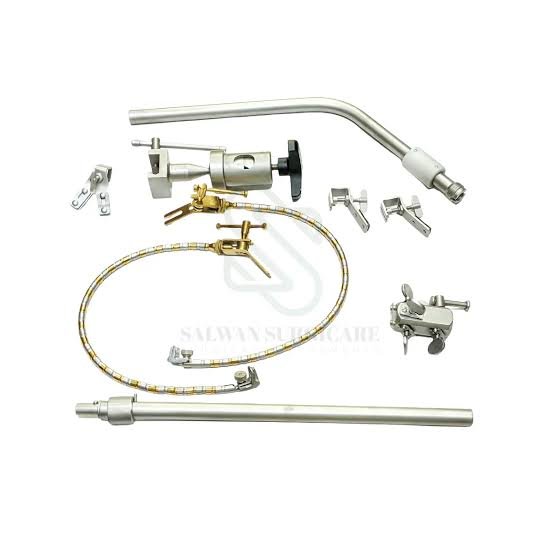
Leyla Retractor: Uses, Components and Applications in Neurosurgery
In neurosurgery, exposure is measured in millimetres. The surgeon works through a small opening, under a microscope, often deep below the brain surface, and both hands are needed for dissection. Even a small shift in a hand-held spatula can blur the view or put pressure on delicate brain tissue. A self-retaining retractor solves this by holding the spatula still for as long as the surgeon needs. The Leyla retractor is one of the best-known examples of this design.
This guide explains what a Leyla retractor is, how its components fit together, where it is used, and what hospitals and distributors should consider when sourcing one. The retractor is named after Leyla Yaşargil, daughter of Professor M. Gazi Yaşargil, the pioneer of microneurosurgery whose work shaped the instrument. Today, “Leyla” is widely used to describe this style of flexible-arm brain retractor. Salwan Surgicare offers neurosurgical retractors as part of its wider range of surgical retractors.
What Is a Leyla Retractor?
A Leyla retractor is a self-retaining brain retraction system. A base fixes to the head holder or the operating table, and one or more flexible arms carry brain spatulas that gently hold tissue aside. Each arm can be bent into almost any position while loose, then made rigid with a single tightening knob. This lets the surgeon place a spatula exactly where it is needed, at the right angle and depth, and leave it there while both hands stay free for microsurgery.
Because the arms are slim and flexible, they stay out of the microscope’s line of sight and the surgeon’s working space. The same base can carry one, two, or more arms, so the system adapts to very different approaches and operations.
Main Components of a Leyla Retractor System
- Fixation clamp or mount: attaches the system to a skull clamp (head holder) or to the table rail, so the retractor moves with the patient’s head and stays stable throughout the case.
- Base bar or fixation post: the rigid support from which the arms extend. Some systems use a single bar, others a frame or extension bars to place arms around the craniotomy.
- Flexible arms: the defining feature. Each arm is made of interlocking links threaded on an internal cable. When loose, the arm can be shaped freely; when the knob is tightened, the cable pulls the links together and the arm locks rigid.
- Tightening knob or wing nut: controls the tension in the arm, allowing quick switching between flexible and fixed.
- Spatula holder: a small clamp at the end of each arm that grips the brain spatula securely.
- Brain spatulas: the parts that touch tissue. They come in a range of widths and tapers and are usually malleable, so the surgeon can bend them to fit the surgical corridor.
- Accessories: optional items such as extra arms, extension bars, joint clamps, and holders for other instruments, depending on the procedure.
How a Leyla Retractor Is Set Up
- Fix the patient’s head in the head holder and confirm the approach with the surgeon.
- Attach the retractor mount to the head holder or table rail and check that it is secure before draping or according to the team’s routine.
- Position the base bar so the arms can reach the craniotomy without blocking the microscope.
- Prepare the spatulas, bending them to the shape the surgeon prefers, and protect the brain surface with cottonoids or patties.
- Place each spatula with the arm loose, then tighten the knob to lock it, using the minimum retraction needed for a clear view.
- Reassess during the case. Surgeons release, reposition, or remove spatulas as the dissection progresses to reduce pressure on brain tissue.
Source Surgical Retractors Built for Stable, Reliable Exposure
Self-retaining, neurosurgical, abdominal, cardiovascular and orthopedic retractors in medical-grade stainless steel
EXPLORE RETRACTORSUses and Applications in Surgery
Leyla-type brain retractors are most valuable in microsurgical procedures where precise, steady exposure is needed.
- Cerebral aneurysm and vascular surgery: holds the frontal or temporal lobe gently aside to reach vessels at the base of the brain.
- Brain tumour surgery: provides a stable corridor for removing meningiomas, gliomas, and other lesions.
- Skull base surgery: supports pterional, subfrontal, and other skull base approaches where the working space is deep and narrow.
- Posterior fossa surgery: retracts the cerebellum for access to the cerebellopontine angle and nearby structures.
- Spinal surgery: flexible arms can also hold retractor blades or instruments in selected spinal procedures.
- Long microsurgical cases: consistent, hands-free retraction lets the surgeon and assistant concentrate on fine dissection.
The configuration depends on the approach, the patient’s anatomy, and the surgeon’s preference, so teams usually keep several spatula sizes and more than one arm available.
Benefits of a Flexible-Arm Retractor
- Stable exposure: the spatula does not move when the surgeon changes instruments or looks away.
- Both hands free: the surgeon can work bimanually under the microscope.
- Precise positioning: flexible arms can be shaped to any angle and locked with one knob.
- Unobstructed view: slim arms stay out of the microscope’s line of sight.
- Adaptability: one base can support multiple arms for different approaches.
Limitations and Safety Considerations
- Brain retraction injury: sustained pressure from a spatula can injure brain tissue or compress vessels. Modern microneurosurgery emphasises minimal retraction, frequent repositioning, and brain relaxation techniques.
- Arm drift: worn cables or links may let an arm slowly lose tension. Arms should be checked before every case.
- Setup time: the scrub team needs training to assemble and position the system quickly.
- Cleaning challenges: the many links and internal cable can trap debris and require careful reprocessing.
- Instrument counts: every spatula, arm, clamp, and accessory must be counted before and after the case.
Leyla-Type Retractor vs Other Common Brain Retractors
| Retractor type | How it is held | Typical use |
|---|---|---|
| Leyla-type retractor | Flexible arms fixed to head holder or table | Microsurgical cranial and skull base exposure |
| Greenberg retractor | Flexible arms on a table- or head-holder-mounted frame | Cranial and spinal procedures |
| Budde Halo retractor | Ring fixed to the head holder with retractor arms | Cranial and skull base surgery |
| Sugita frame retractor | Frame around the head holder with flexible arms | Aneurysm and skull base surgery |
| Hand-held brain spatula | Held by surgeon or assistant | Short, dynamic retraction |
Most neurosurgical theatres keep both: a self-retaining system for steady, prolonged exposure and hand-held spatulas for quick, dynamic retraction.
Cleaning and Sterilisation
Flexible arms have many small links, an internal cable, and threaded parts that can trap blood and debris. Disassemble the system as far as the manufacturer allows, clean each part with an enzymatic detergent, flush and brush the arms and joints, and rinse and dry thoroughly before packaging. Inspect spatulas for kinks, cracks, and sharp edges, test each arm to confirm it locks firmly and releases smoothly, and follow the manufacturer’s instructions for steam sterilisation. Keep all components together in a labelled tray so none are lost between cases.
What to Look For When Buying
- Material and finish: medical-grade stainless steel with a passivated, corrosion-resistant surface.
- Locking reliability: arms should lock rigid with a single turn and hold position without drifting.
- Spatula range: a good selection of widths and tapers, so the system suits several approaches.
- Compatibility: confirm the mount fits your head holder or operating table rails.
- Autoclave durability: arms and cables should survive repeated cycles without loosening or stiffening.
- Documentation and warranty: request certificates, specifications, and a written guarantee.
Why Choose Salwan Surgicare
Since 1997, Salwan Surgicare has supplied CE-marked, ISO 13485:2016 certified instruments to hospitals and distributors worldwide. Its retractor range includes more than 7200 products spanning general, cardiovascular, orthopedic, ENT, and neurosurgical designs, all made from medical-grade stainless steel and covered by a one-year quality guarantee. OEM and private label options are available for distributors. Browse the complete neurosurgery instruments range to build a full set around your retractors.
Conclusion
A Leyla retractor gives neurosurgeons stable, precise, hands-free exposure in delicate microsurgical operations. Its value comes from the combination of a secure mount, flexible arms that lock with a single knob, and a good range of malleable spatulas. Choose a system with reliable locking, durable materials, and clear documentation, train your team on setup, cleaning, and counts, and always use the gentlest retraction that gives the view the surgeon needs.
Get a Custom Quote for Bulk Retractor Orders
Consistent quality, export-ready packaging, and OEM support for hospitals and distributors worldwide
REQUEST A QUOTE