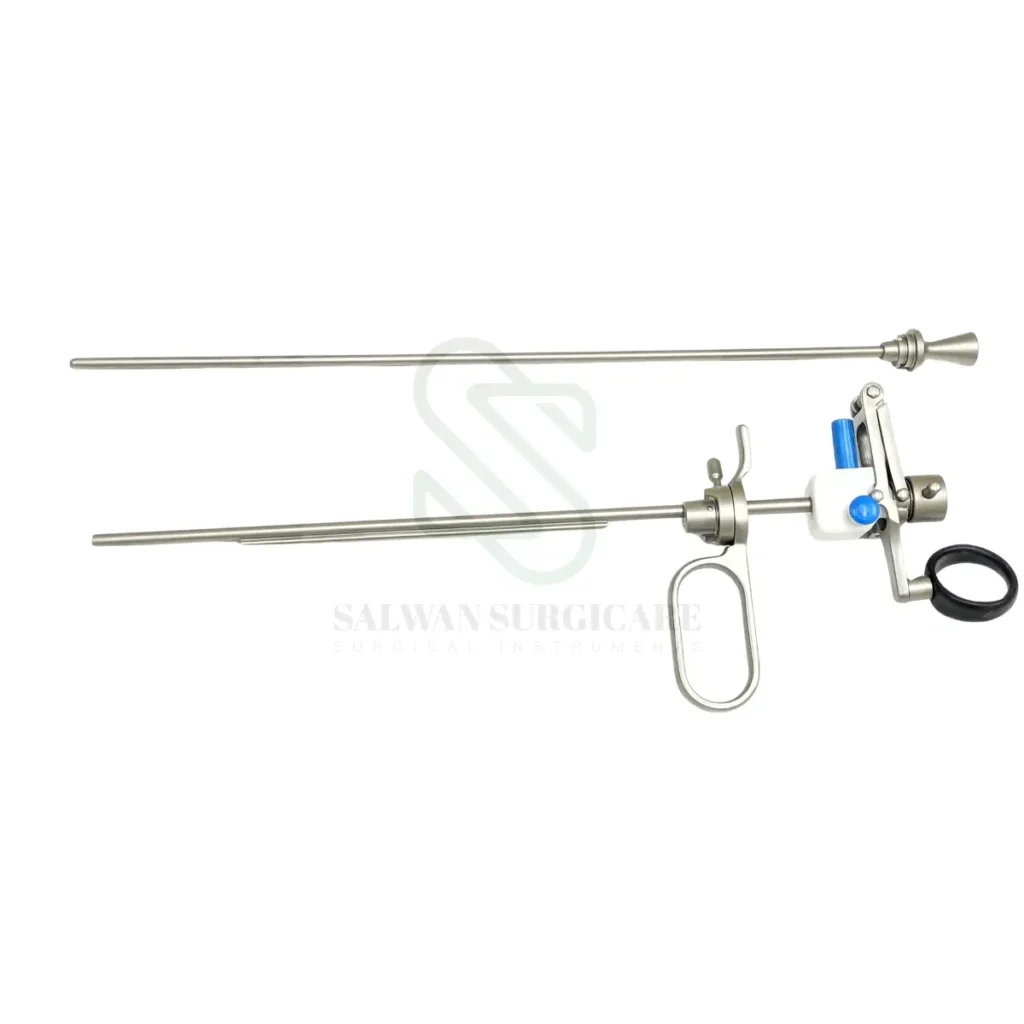
TURP Instruments: Complete Set, Uses and Components
Transurethral resection of the prostate, usually shortened to TURP, remains one of the standard operations for benign prostatic hyperplasia (BPH) when medication no longer controls urinary symptoms. The surgeon reaches the prostate through the urethra, so there is no external incision, and removes obstructing tissue with an electrosurgical loop. The whole operation depends on one carefully matched instrument system.
For hospitals, urology departments, and distributors, knowing exactly what a TURP instruments set contains makes purchasing easier and avoids compatibility mistakes. This guide covers the complete set, the role of each component, how the instruments are used, and what to look for when sourcing. Salwan Surgicare supplies a wide range of urology instruments, including resectoscopes in monopolar and bipolar configurations.
What Is a TURP Instrument Set?
A TURP set is built around the resectoscope, a rigid endoscope designed to view and cut tissue at the same time. It is supported by sheaths, electrodes, a telescope, and accessories for irrigation and clot removal. Sets are usually grouped as monopolar or bipolar depending on the energy system, and most are reusable and autoclavable.
Core Components of the Resectoscope
- Outer sheath: the tube that goes into the urethra. It carries irrigation fluid in and out. Common adult sizes range from about 24 Fr to 27 Fr, with 26 Fr widely used.
- Inner sheath: sits inside the outer sheath and allows continuous flow, so the bladder stays at a safe pressure and the view stays clear. Together, the two sheaths form a continuous-flow system.
- Obturator: a blunt, rounded insert that fills the sheath during insertion so the tip does not injure the urethra. It is removed before the telescope and working element go in.
- Telescope: a rigid optical system, commonly 4 mm in diameter with a 30-degree viewing angle. It gives the surgeon a magnified view of the prostatic urethra and bladder neck. Salwan’s wider endoscopes range covers related optics.
- Working element: the handle mechanism that moves the cutting loop back and forth. It may be passive (spring-loaded, thumb-controlled) or active, and it must match the sheath and electrode type.
- Cutting loop electrode: a thin wire loop, typically 3 to 4 mm, that cuts and coagulates tissue as it is drawn back through the prostate. Monopolar and bipolar loops are not interchangeable.
- Electrosurgical cable: connects the working element to the generator.
- Light cable and camera: link the telescope to the light source and video system so the whole team can follow the procedure.
Monopolar vs Bipolar TURP Sets
| Feature | Monopolar | Bipolar |
| Current path | Passes through the patient to a return pad | Returns between electrodes at the tip |
| Irrigation fluid | Non-electrolyte fluid such as glycine or sorbitol | Normal saline |
| Main fluid concern | Fluid absorption and TUR syndrome risk | Lower electrolyte risk, but fluid overload is still possible |
| Return pad needed | Yes | No |
| Typical use | Long-established, widely available | Increasingly common in modern theatres |
The choice between systems depends on the hospital’s generator, surgeon preference, and fluid protocols. Before ordering, confirm that the working element, loops, and cable all match the generator and each other.
Looking for Reliable TURP and Urology Instruments?
FDA, CE and ISO 13485 certified resectoscopes, sheaths and urology sets, built for repeated sterilisation.
EXPLORE UROLOGY INSTRUMENTSSupporting Instruments in a TURP Tray
- Cystoscope and cystoscopy sheath: used for an initial inspection of the urethra and bladder before resection.
- Urethral bougie dilators: help open a narrow urethra so the sheath can pass without trauma. See the full probes and dilators category for more sizes.
- Otis urethrotome: used to treat urethral strictures that would otherwise block the sheath.
- Ellik evacuator: a bulb-and-glass device that flushes out resected prostate chips from the bladder at the end of resection.
- Catheters: a three-way catheter is typically placed afterwards for continuous bladder irrigation.
- Irrigation tubing and fluid bags: provide the continuous flow that keeps the field clear.
How the Instruments Are Used in the Operation
- Preparation and positioning: the patient is placed in the lithotomy position and the equipment is checked for matching sizes and working connections.
- Urethral inspection: a cystoscope or the resectoscope with its obturator is passed carefully, and dilation is used if the urethra is tight.
- Assembly: the telescope and working element are fitted and connected to light, camera, irrigation, and the electrosurgical unit.
- Resection: the surgeon cuts the obstructing prostate tissue in strips using the loop, working systematically and controlling bleeding with coagulation.
- Chip evacuation: the Ellik evacuator or irrigation clears the resected chips from the bladder.
- Catheterisation: a catheter is placed and irrigation continues as needed after the operation.
Safety Points the Set Helps Support
- Insulation integrity: cracked insulation on sheaths or cables can lead to stray current, so each piece should be inspected before use.
- Fluid management: keeping irrigation flow continuous and watching fluid balance reduces the risk of fluid absorption. Hospitals should follow their own protocols.
- Correct matching: mixing incompatible working elements, loops, or cables is a common cause of poor cutting and avoidable faults.
TURP in Context: Why the Instrument Set Still Matters
Newer options such as laser enucleation and bipolar vaporisation have joined the toolbox for treating an enlarged prostate, but resection with a resectoscope remains widely taught, widely available, and cost-effective, especially in high-volume hospitals. Many of the same sheaths, telescopes, and working elements are also used in related endoscopic procedures, such as resection of bladder tumours. For a procurement team, that means a well-chosen resectoscope set supports several procedures and holds its value across years of use.
Care, Cleaning and Sterilisation
TURP instruments have narrow channels, optics, and delicate wires that need gentle handling. Clean them soon after use, flush channels thoroughly, and keep telescopes in protective trays so the lenses are not knocked. Follow the manufacturer’s instructions for use for sterilisation, because telescopes and electrodes can have different heat tolerance than plain stainless steel instruments. Replace worn loops promptly, since a damaged loop cuts poorly and bleeds more.
How to Choose a TURP Instruments Supplier
- Ask for a clear list of every item in the set and its size.
- Confirm compatibility with your telescope, camera, light source, and generator.
- Check certifications, such as ISO 13485 and CE, and request supporting documents.
- Request samples before placing a bulk order.
- Ask about spare loops, sheaths, and working elements, since consumable parts wear faster than the main body.
Why Choose Salwan Surgicare
Salwan Surgicare has manufactured surgical instruments in India since 1997 and supplies urology departments, distributors, and OEM brands worldwide. Urology sets can be customised to your protocols, and every instrument is checked for finish, movement, and optical compatibility before shipment. Products are made from medical-grade stainless steel, backed by a one-year quality guarantee, and supported by export-ready packaging and documentation.
Conclusion
A TURP set is more than a resectoscope. It is a matched system of sheaths, a telescope, a working element, electrodes, and accessories, and it works best when every part is compatible and well maintained. Define your energy system first, confirm sizes, and choose a supplier who can provide a complete, documented set.
Request a Customised Urology Instrument Set
Specifications, catalogues, bulk pricing, and export support for hospitals and distributors.
REQUEST A QUOTE