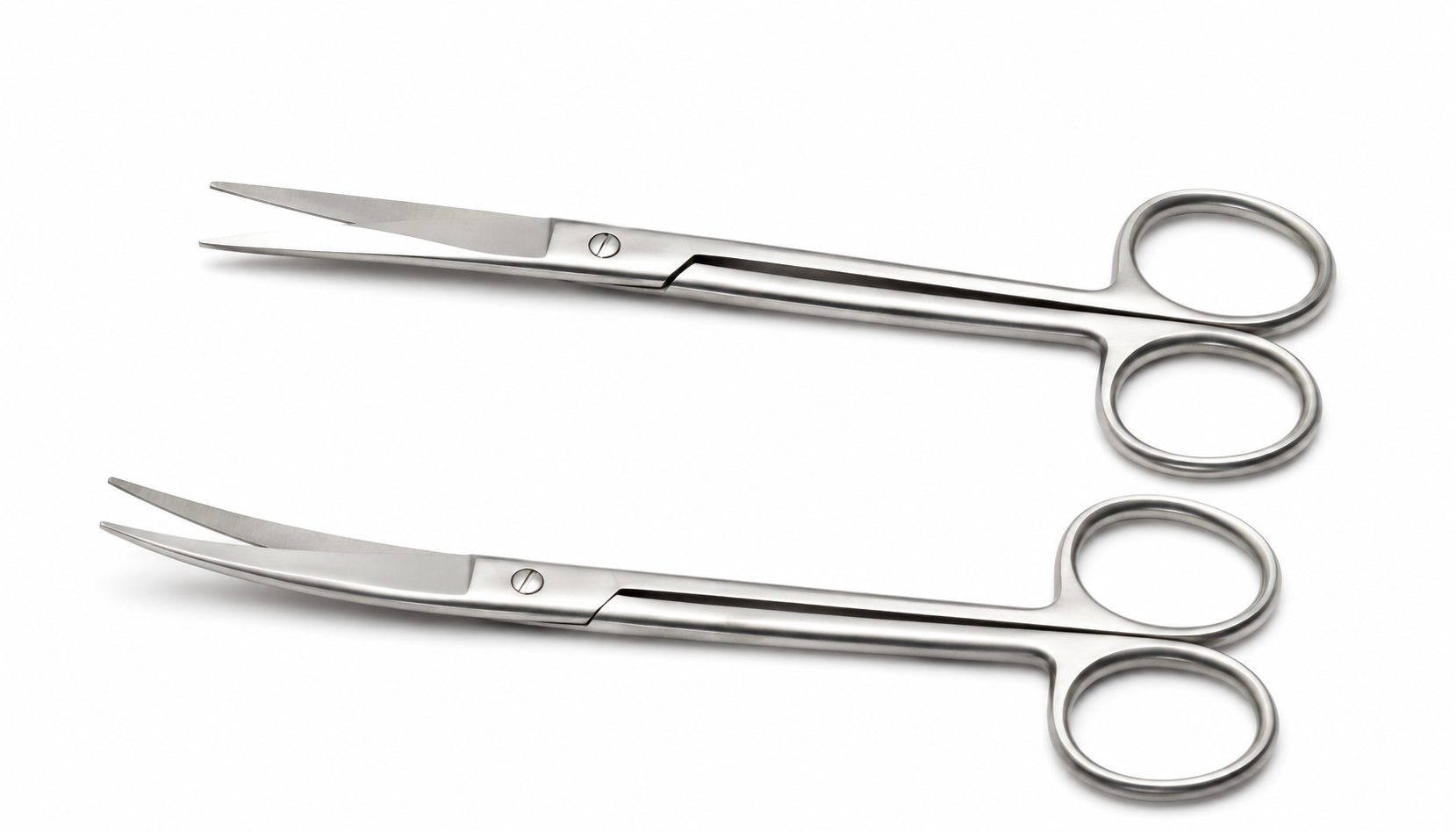
Straight vs Curved Surgical Scissors: Differences, Uses and Which One to Choose?
Surgical scissors are among the most frequently used instruments in any operating room, and the choice between a straight or curved blade can directly affect precision, tissue handling, and surgical outcomes. Salwan Surgicare manufactures a comprehensive range of surgical scissors, including operating scissors, Metzenbaum scissors, Mayo scissors, dissecting scissors, and other specialised patterns used across general surgery, gynaecology, orthopaedics, cardiovascular procedures, and microsurgery.
In this blog, we compare straight and curved surgical scissors, explain where each is used, and help you decide which pattern is right for your procedure or your facility’s instrument tray.
What Are Straight Surgical Scissors?
Straight surgical scissors have a linear cutting edge running the full length of the blade. This design gives surgeons a direct, unobstructed line of sight to the cutting point, making straight scissors ideal for surface-level and superficial work such as cutting sutures, dressings, and tissue that lies in a straight, accessible plane.
Common straight patterns in Salwan Surgicare’s range include Dressing Scissors for bandage and dressing removal, and Episiotomy Scissors, used in gynaecology and obstetric procedures. Straight blades are generally easier to control for linear cuts and are a staple in general surgery trays.
What Are Curved Surgical Scissors?
Curved surgical scissors have blades that follow a gentle arc, allowing surgeons to see around the tip of the instrument as they cut. This curvature improves visibility when working around tissue contours, in confined spaces, or during delicate dissection where a straight blade would obstruct the view.
Popular curved patterns include Iris Scissors for microsurgery, Angular Scissors for controlled angled cutting, and Cottle Dorsal Scissors, widely used in rhinoplasty and septoplasty. The curved design gives surgeons better control when dissecting around organs, vessels, or contoured tissue.
Key Differences Between Straight and Curved Scissors
Here’s a side-by-side comparison of the two blade styles:
| Parameter | Straight Scissors | Curved Scissors |
|---|---|---|
| Blade Design | Linear cutting edge | Gently curved cutting edge |
| Visibility | Direct line of sight to blade tip | Better visibility around tissue contours |
| Best For | Surface cuts, sutures, dressings | Deep or contoured tissue dissection |
| Control | High precision for linear cuts | High precision for delicate, curved dissection |
| Common Use | General surgery, dressing removal | Ophthalmic, ENT, plastic & microsurgery |
Common Uses of Straight Surgical Scissors
- Suture and dressing removal using Dressing Scissors
- Umbilical cord cutting during delivery, using Cord Cutting Scissors
- Episiotomy procedures in obstetrics, using Episiotomy Scissors
- General cutting tasks where a straight, direct line of sight is preferred
Common Uses of Curved Surgical Scissors
- Ophthalmic microsurgery, using Castroviejo Corneal Scissors and De Wecker Scissors
- Cardiac valve procedures, using Dietrich Valve Scissors
- Laparoscopic dissection, using the Hook Scissor
- Plastic and reconstructive surgery, using Kilner (Ragnell) Scissors
Advantages and Limitations of Each Type
Straight scissors are simple to control, easy to sharpen, and cost-effective for high-frequency, low-complexity cutting tasks. Their main limitation is reduced visibility once the blade tip moves into deeper or contoured tissue.
Curved scissors offer better visualisation and control during delicate dissection, especially in microsurgery and confined anatomical spaces. Their limitation is that they generally require more skill to control accurately and are typically reserved for specialised tasks rather than routine cutting.
Browse Our Complete Range of Surgical Scissors
Operating, Mayo, Metzenbaum, Iris, dissecting and dressing scissors — precision-crafted for every specialty.
SHOP SURGICAL SCISSORSWhich One Should You Choose?
The right choice depends on the procedure, not personal preference alone. For dressing changes, suture removal, and straightforward linear cuts, straight scissors are the practical choice. For dissection around organs, vessels, or contoured anatomy — particularly in ophthalmic, ENT, cardiovascular, or plastic surgery — curved scissors provide better control and visibility. Most operating rooms stock both patterns across their scissors range to be prepared for every type of procedure.
Why Choose Salwan Surgicare for Surgical Scissors
Salwan Surgicare manufactures its surgical scissors from premium medical-grade stainless steel, with select models featuring tungsten carbide inserts for enhanced cutting performance and extended instrument life. Every pattern — straight or curved — is engineered for smooth cutting action, consistent alignment, and repeated sterilisation, and comes with a 1-year quality guarantee.
Conclusion
Straight and curved surgical scissors each serve a distinct purpose in the operating room. Understanding when to reach for which pattern helps surgical teams work more efficiently and precisely. Whether you need straight scissors for everyday cutting tasks or curved scissors for delicate dissection, choosing instruments built to consistent quality standards makes all the difference in performance and longevity.
Get a Custom Quote for Bulk Scissors Orders
Consistent quality, export-ready packaging, and reliable supply for hospitals and distributors worldwide.
REQUEST A QUOTE