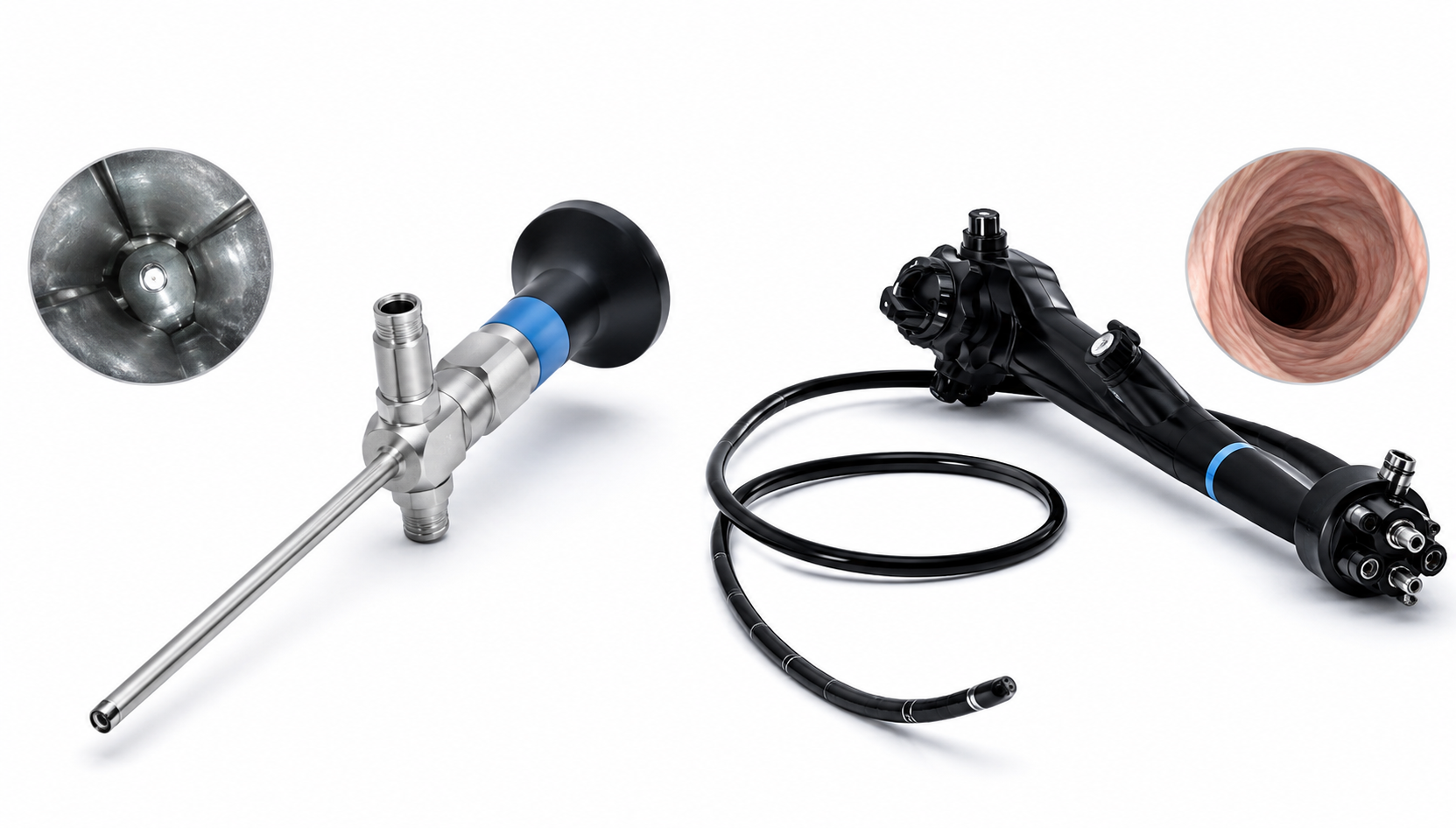
Rigid vs Flexible Endoscopes: Differences, Uses and Which Is Better?
Endoscopes have transformed the way surgeons diagnose and treat internal conditions, allowing them to view organs and tissues without large incisions. Whether it’s a routine diagnostic procedure or a complex minimally invasive surgery, choosing the right type of endoscope makes a significant difference in visualization, precision, and patient outcomes. Hospitals, surgeons, and distributors generally work with two broad categories of endoscopes: rigid and flexible. Each is engineered for specific clinical situations, and understanding their differences helps procurement teams make informed sourcing decisions.
In this blog, we break down what separates rigid and flexible endoscopes, where each is used, and which one might be the right fit for your surgical needs. As a leading endoscopes manufacturer, Salwan Surgicare supplies a full range of CE-certified rigid endoscopes designed for durability, clarity, and consistent performance across specialties.
What Is a Rigid Endoscope?
A rigid endoscope is a straight, non-bending tube built around a precision rod-lens optical system. Because the shaft doesn’t flex, rigid endoscopes deliver sharper, higher-resolution images compared to many flexible alternatives, making them ideal for procedures that demand fine detail. These instruments are typically manufactured from medical-grade stainless steel and are designed for repeated autoclave sterilization without compromising optical clarity or structural integrity.
Rigid endoscopes are available in multiple diameters, lengths, and viewing angles — 0°, 30°, 45°, and 90° — to suit different anatomical access points and surgical techniques. Salwan Surgicare’s range of rigid endoscopes includes laparoscopes, arthroscopes, cystoscopes, sinuscopes, and hysteroscopes, all built for precision, strength, and long-term reliability in demanding operating room environments.
What Is a Flexible Endoscope?
A flexible endoscope uses a bendable insertion tube, usually built with fiber-optic bundles or a miniature digital camera at the tip, allowing it to navigate curved or hard-to-reach anatomical pathways. This flexibility makes it especially useful in procedures where the scope must travel through winding structures such as the gastrointestinal tract, airways, or urinary system.
Flexible endoscopes generally offer a wider range of motion and can be steered around bends, but their optical clarity and long-term durability can vary depending on build quality. Because they contain more delicate internal components, flexible scopes typically require more careful handling and specialised reprocessing protocols. They are commonly used in gastroenterology, pulmonology, and select urology and ENT applications where rigid access isn’t possible.
Key Differences Between Rigid and Flexible Endoscopes
While both instrument types serve the same core purpose of internal visualisation, they differ significantly in design, application, and performance. The table below summarises the main points of comparison:
| Parameter | Rigid Endoscope | Flexible Endoscope |
|---|---|---|
| Structure | Fixed, non-bending shaft | Bendable, steerable shaft |
| Image Quality | High-resolution rod-lens optics | Good, but varies with build quality |
| Maneuverability | Straight-line access only | Navigates curved anatomical paths |
| Common Use | Laparoscopy, arthroscopy, cystoscopy, sinus surgery | Gastroscopy, bronchoscopy, colonoscopy |
| Durability | Highly durable, easy to sterilise | More delicate, needs careful reprocessing |
| Cost | Generally more cost-effective | Typically higher due to complex components |
Common Applications of Rigid Endoscopes
Rigid endoscopes are the preferred choice wherever surgeons need a straight-line path to the surgical site combined with excellent optical clarity:
- Laparoscopy: Laparoscopes are used for abdominal and pelvic surgeries, including gallbladder removal and hernia repair.
- Arthroscopy: Arthroscopes allow surgeons to examine and treat joint conditions with minimal disruption to surrounding tissue.
- Urology: Cystoscopes are used for bladder and urinary tract examinations and treatments.
- ENT & Sinus Surgery: Sinuscopes support precise visualisation during nasal and sinus procedures.
Common Applications of Flexible Endoscopes
Flexible endoscopes are essential wherever the diagnostic or surgical pathway isn’t a straight line:
- Gastroenterology: used in gastroscopy and colonoscopy to examine the digestive tract.
- Pulmonology: bronchoscopes examine the airways and lungs.
- Urology: flexible ureteroscopes are used in select stone-management procedures.
Advantages and Limitations of Each Type
Rigid endoscopes offer superior image resolution, a robust build that withstands repeated sterilisation, and a generally lower cost of ownership. Their main limitation is that they cannot navigate curved anatomy, which restricts their use to procedures with direct access.
Flexible endoscopes offer access to curved and narrow passages and can improve patient comfort in certain diagnostic procedures. However, their internal components are more fragile, reprocessing is more involved, and image quality can degrade faster with heavy use.
Which Is Better – Rigid or Flexible Endoscope?
Neither type is universally “better” — the right choice depends entirely on the procedure, the anatomical access required, and the image quality needed. For laparoscopic, arthroscopic, urological, and ENT procedures that allow direct, straight-line access, rigid endoscopes remain the gold standard for clarity and durability. For procedures that require navigating the digestive tract or airways, flexible endoscopes are the appropriate choice. Many hospitals maintain both types to cover their full range of diagnostic and surgical needs.
Need CE-Certified Rigid Endoscopes for Your Hospital or Distribution Network?
Explore laparoscopes, arthroscopes, cystoscopes and sinuscopes engineered for precision and durability.
REQUEST A QUOTEWhy Choose Salwan Surgicare for Endoscopy Equipment
As a trusted surgical instruments manufacturer and exporter since 1997, Salwan Surgicare supplies CE-certified, ISO 13485:2016 and ISO 9001:2015 compliant endoscopy equipment to hospitals, distributors, and medical companies worldwide. Every rigid endoscope is manufactured from medical-grade stainless steel and optics-grade materials, tested for repeated sterilisation, and backed by a quality guarantee — with fast international shipping and technical support included.
Conclusion
Both rigid and flexible endoscopes play a critical role in modern medicine, and understanding their differences helps you equip your facility correctly for the procedures you perform most. If your priority is sharp optics, durability, and straightforward sterilisation for laparoscopic, arthroscopic, urological, or ENT procedures, a rigid endoscope is usually the better long-term investment.
Explore Our Full Range of Endoscopy Equipment
CE-certified rigid endoscopes in HD, 4K and 8K — built for consistent performance, batch after batch.
Browse Endoscopy Equipment