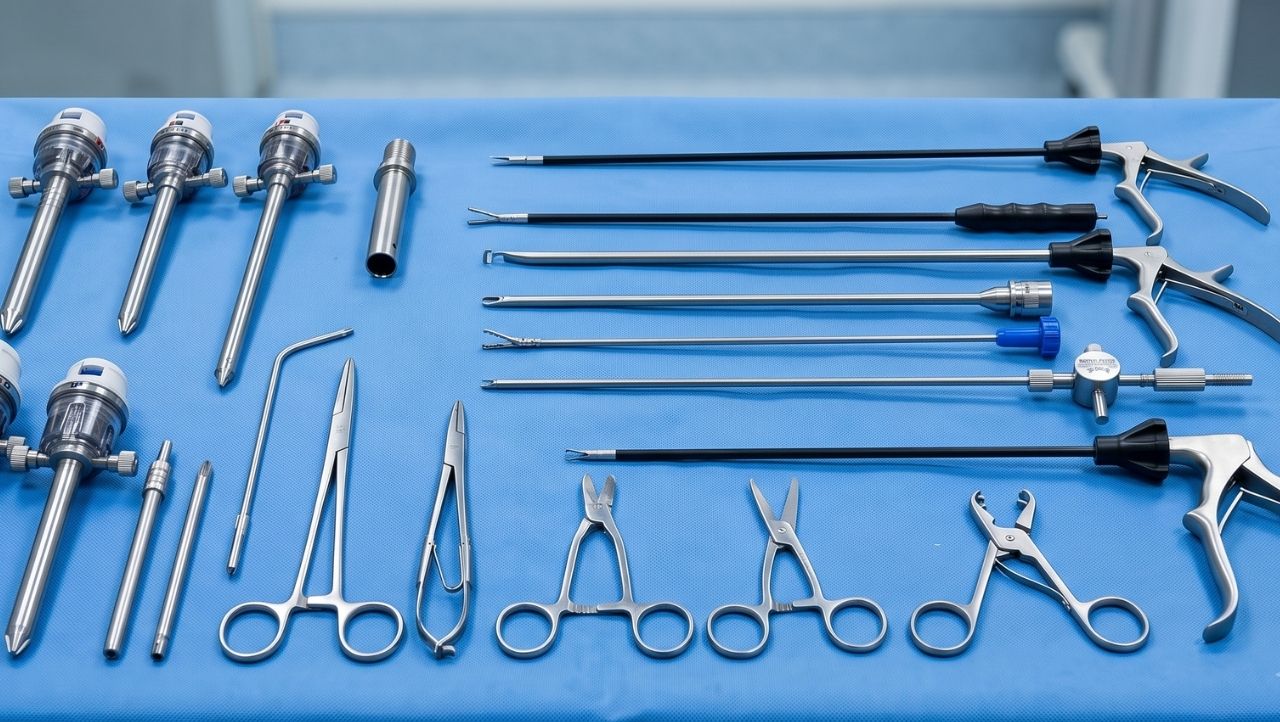
Laparoscopic Instruments for Cholecystectomy: Complete Set List and Uses
Laparoscopic cholecystectomy requires a specialized set of laparoscopic instruments to safely remove the gallbladder through minimal abdominal incisions. The primary tools include trocars and cannulas for port access, atraumatic graspers for tissue manipulation, Maryland dissectors for fine tissue separation, monopolar and bipolar electrosurgical instruments for hemostasis, clip applicators for ligating the cystic duct and artery, laparoscopic scissors for precise cutting, suction-irrigation cannulas for site clearing, and needle holders for secure internal suturing.
Dive through this guide to learn the complete set list, specific uses, procedural roles, and key maintenance guidelines for these surgical tools.
Overview of Gallbladder Surgery Instruments
Gallbladder removal (cholecystectomy) is one of the most frequently performed minimally invasive procedures worldwide. Performing this procedure safely depends on high-precision laparoscopic instruments that grant surgeons optimal control, tactile feedback, and visualization within the abdominal cavity.
Using specialized laparoscopic cholecystectomy instruments minimizes surgical trauma, reduces recovery times, and ensures precise dissection around critical anatomical structures such as Calot’s triangle.
Complete Laparoscopic Cholecystectomy Instrument Set List
Below is the structured breakdown of the primary surgical instruments used for laparoscopic cholecystectomy:
| Instrument Category | Specific Tool | Primary Clinical Function |
| Access & Port Entry | Trocar and Cannula Set | Establishes leak-free abdominal entry channels for camera and working tools. |
| Grasping & Holding | Laparoscopic Grasper (Atraumatic & Fenestrated) | Holds, retracts, and manipulates gallbladder tissue without tearing. |
| Cutting & Ligation | Laparoscopic Scissors (Curved & Straight) | Cuts tissue, adhesions, and ligated structures with micro-sharp edges. |
| Duct & Vessel Closure | Laparoscopic Clip Applicator | Secures titanium or polymeric clips onto the cystic duct and cystic artery. |
| Hemostasis & Cautery | Bipolar and Monopolar Instruments | Delivers thermal energy for controlled tissue division and coagulation. |
| Field Clearing | Suction and Irrigation Cannula | Flushes fluids and evacuates blood or bile to maintain a clear visual field. |
| Suturing & Closure | Laparoscopic Needle Holder | Holds surgical needles securely for fascial or tissue suturing. |
Detailed Uses and Functions of Each Instrument
1. Laparoscopic Trocar and Cannula
An essential instrument used in laparoscopic cholecystectomy, the trocar and cannula assembly provides initial access to the peritoneal cavity.
- Function: Punctures the abdominal wall to create fixed working channels (typically 5mm and 10mm ports).
- Key Features: Engineered with leak-free seals to maintain pneumoperitoneum ($CO_2$ gas pressure) throughout the procedure.
- Usage in Cholecystectomy: Used to insert the laparoscope camera and introduce operating tools like graspers, scissors, and clip applicators.
2. Laparoscopic Grasper (Atraumatic & Fenestrated)
Tissue manipulation without causing inadvertent organ rupture is critical when handling an inflamed gallbladder.
- Atraumatic Graspers: Feature broad, smooth jaws that exert gentle pressure, ideal for retracting the gallbladder fundus.
- Fenestrated Graspers: Include jaw openings that enhance visibility and grip strength on slippery visceral walls.
- Clinical Role: Enables steady exposure of Calot’s triangle by lifting and orienting the gallbladder.
3. Laparoscopic Scissors
Surgical cutting requires maximum precision to prevent collateral tissue damage.
- Styles Available: Curved Micro-Scissors (Metzenbaum style) and Straight Scissors.
- Key Benefits: Precision-ground stainless steel edges ensure clean cuts without pulling tissue.
- Usage: Used to divide the cystic duct and cystic artery once clips have been securely applied.
4. Laparoscopic Clip Applicator
Ligation of vital structures is a critical milestone during gallbladder removal.
- Mechanism: Mechanical or reusable ratchet-action instrument designed to hold and squeeze clips onto blood vessels and ducts.
- Role in Cholecystectomy: Applies multiple mechanical clips to the cystic duct and cystic artery to permanently prevent bile leakage and post-operative hemorrhage.
5. Monopolar and Bipolar Instruments
Electrosurgical safety and fluid coagulation are mandatory during liver bed dissection.
- Monopolar Cautery Hooks/Forceps: Delivers current through target tissue to achieve rapid cutting and hemostasis along the gallbladder bed.
- Bipolar Forceps: Passes current strictly between two instrument tips, offering safer, highly targeted coagulation near delicate structures.
6. Suction and Irrigation Cannula
Maintaining an unobstructed view of the surgical field is vital for patient safety.
- Dual Channel System: Allows instant switching between saline irrigation and fluid suction.
- Role in Cholecystectomy: Clears blood, bile spills, or debris from the subhepatic space to verify complete hemostasis before closure.
7. Laparoscopic Needle Holder
Suturing is required for port-site fascial closure or intraoperative repairs.
- Jaws & Ergonomics: High-friction tungsten carbide jaws prevent needle twisting under abdominal pressure.
- Usage: Ensures firm grip and precise needle manipulation when suturing fascia or internal tissue layers.
Procedural Workflow: Step-by-Step Instrument Deployment
- Abdominal Access: Trocars establish primary and secondary ports under direct visualization.
- Retraction & Exposure: Graspers pull the gallbladder superiorly to expose the cystic structures.
- Skeletonization: Dissectors and electrocautery isolate the cystic duct and cystic artery.
- Ligation & Division: Clips are placed across the duct and artery, followed by division with scissors.
- Bed Separation: The gallbladder is dissected off the liver bed using monopolar hook cautery.
- Irrigation & Inspection: The subhepatic cavity is thoroughly irrigated and inspected for bleeding or bile leaks.
Quality, Sterilization, and Maintenance Standards
To ensure safety and procedural repeatability, medical-grade laparoscopic instruments must adhere to rigorous quality benchmarks:
- Material Standard: Crafted from high-grade, corrosion-resistant surgical stainless steel.
- Insulation Integrity: Electrical insulation on electrosurgical shafts prevents accidental thermal burns to non-target tissue.
- Sterilization Compatibility: Fully withstands repeated steam autoclaving, ultrasonic cleaning, and chemical sterilization protocols without losing alignment or cutting sharpness.
- Quality Certification: Manufactured in compliance with CE and ISO 13485 international standards.
Hospital procurement teams prioritizing high-grade laparoscopic cholecystectomy instruments can significantly reduce repair frequency, extend instrument lifecycle, and improve surgical efficiency across operating rooms.
Upgrade Your Operating Room with Salwan Surgicare
Salwan Surgicare is a premier manufacturer and global exporter of CE-certified surgical instrumentation. We supply high-precision, durable, and ergonomically designed laparoscopic tools to hospitals, surgical centers, and healthcare distributors across 30+ countries.
Whether you need individual replacement tools or complete procedure-specific instrument sets, our products offer uncompromised reliability, precision engineering, and competitive pricing.
Visit our official portal at Salwan Surgicare laparoscopic instruments to browse our product catalog or request bulk pricing for your facility.
Frequently Asked Questions
Essential tools include trocars, cannulas, atraumatic graspers, Maryland dissectors, clip applicators, electrosurgical instruments, laparoscopic scissors, suction-irrigation devices, and specialized laparoscopic needle holders for gallbladder surgeries.
Clip applicators place titanium or polymeric clips to securely ligate the cystic duct and cystic artery, preventing bile leakage and dangerous postoperative internal bleeding complications.
Medical-grade stainless steel tools undergo thorough manual pre-cleaning, ultrasonic washing, drying, and steam autoclaving according to strict clinical infection control standards for reusable surgical equipment.
Monopolar instruments pass current through the patient to a return pad, while bipolar instruments conduct energy solely between the instrument tips for localized tissue coagulation.
Trocars are selected based on the instrument diameter needed for each specific portal, typically ranging from five millimeters to ten millimeters for endoscopic surgical access.