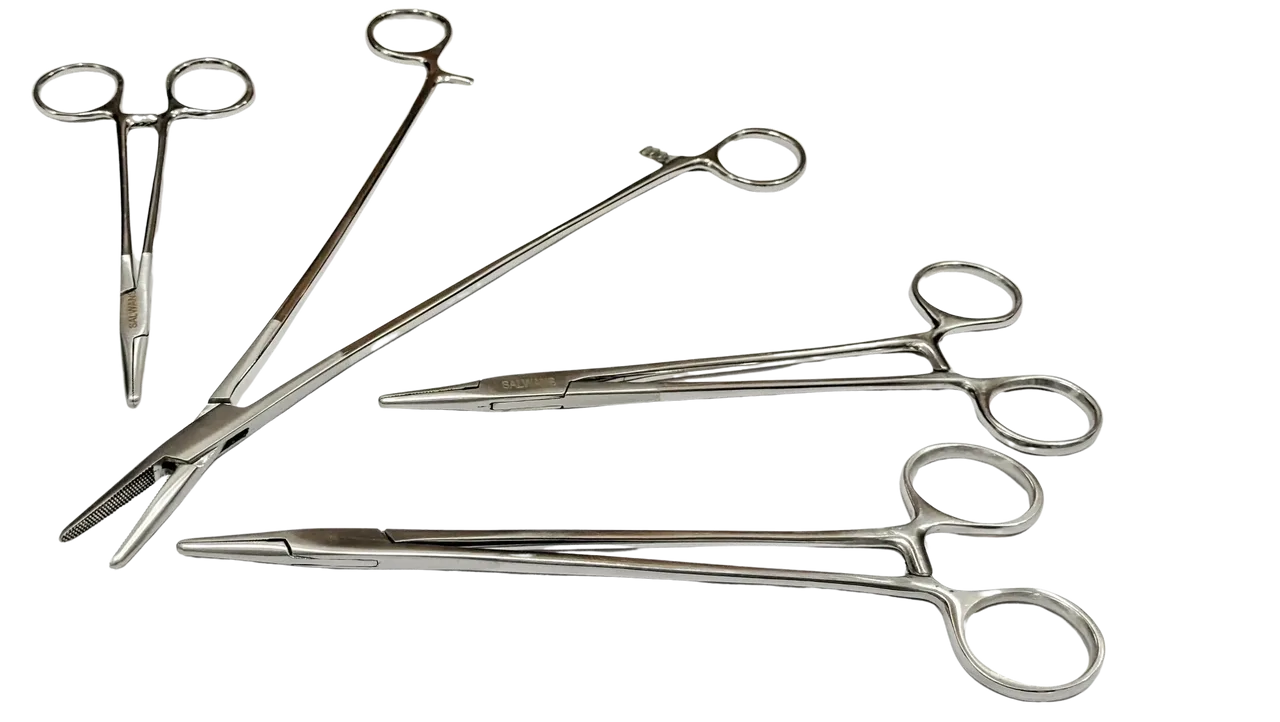
Needle Holders vs Forceps: Why This Comparison Matters
Needle holders and forceps are among the most commonly used surgical instruments, but they are often confused with each other. While both are hand-held, locking instruments, they serve very different purposes in surgery.
Understanding the difference between needle holders and forceps helps surgeons, hospitals, and procurement teams select the right instruments for suturing, clamping, and tissue handling.
This comparison by Salwan Surgicare – a surgical instruments manufacturer explains how needle holders differ from forceps, when each is used, and which types are most suitable for different surgical specialties.
What Is a Needle Holder?
A needle holder (also called a needle driver) is a surgical instrument used specifically for holding and guiding a suturing needle through tissue. It provides controlled grip and precision during wound closure.
Needle holders are designed with:
- Short, strong jaws
- Cross-serrations or tungsten carbide inserts
- A ratchet locking mechanism
- Ring handles for controlled movement
Common needle holder types include Mayo Hegar needle holders for general suturing and Castroviejo needle holders for microsurgery.
Explore different needle holder options here:
What Are Forceps?
Forceps are multipurpose surgical instruments used to grasp, clamp, or hold tissue, blood vessels, or surgical materials. Unlike needle holders, forceps are not designed to hold suturing needles.
Forceps are widely used for:
- Controlling bleeding
- Holding tissue during dissection
- Handling surgical dressings
- Removing foreign material
Common forceps types include artery forceps, mosquito forceps, Kocher forceps, and tissue forceps.
View forceps types used in surgery:
👉 Forceps
Needle Holders vs Forceps: Key Differences
Needle holders
- Designed only for suturing
- Short, thick jaws with strong grip
- Often feature tungsten carbide inserts
- Used to drive needles through tissue
- Common types include Mayo Hegar and Castroviejo
Forceps
- Designed for clamping and holding tissue
- Slim jaws, available in straight or curved patterns
- Used for hemostasis and tissue handling
- Not suitable for holding suturing needles
- Common types include artery forceps and mosquito forceps
When to Use Needle Holders in Surgery
Needle holders are used when:
- Closing surgical wounds
- Suturing blood vessels
- Performing fine tissue repair
- Precision needle control is required
Examples:
- Mayo Hegar needle holders are used in general surgery, gynecology, and orthopedic closure.
- Castroviejo needle holders are preferred in ENT, ophthalmology, and microsurgical procedures.
- Olsen-Hegar needle holders are used when cutting sutures without changing instruments.
When to Use Forceps in Surgery
Forceps are used when:
- Clamping blood vessels to control bleeding
- Holding tissue during dissection
- Handling organs or surgical materials
- Assisting during exposure and retraction
Examples:
- Artery forceps are used for hemostasis.
- Mosquito forceps are used for delicate vessel control.
- Kocher forceps are used for firm tissue gripping.
Specialty-Based Comparison
Different surgical specialties rely on both instruments, but for different reasons:
Needle holders for suturing incisions, forceps for tissue handling and bleeding control.
Castroviejo needle holders for fine sutures, delicate forceps for ear and nasal procedures.
Needle holders for closure, heavy forceps for tissue and bone handling.
Specialized laparoscopic needle holders and laparoscopic graspers replace traditional forceps.
Specialized needle holders and forceps for extremely fine sutures and tissue handling.
Can Forceps Replace Needle Holders?
No.
Using forceps instead of a needle holder can:
- Damage the needle
- Reduce control during suturing
- Increase tissue trauma
- Compromise surgical accuracy
Each instrument is designed for a specific task and should be used accordingly.
Choosing the Right Instrument for Your Surgical Set
When selecting instruments for hospitals or surgical centers:
- Use needle holders only for suturing
- Choose forceps based on tissue type and procedure
- Prefer tungsten carbide needle holders for long-term use
- Match instrument type to surgical specialty
Hospitals often include both needle holders and forceps in standardized surgical instrument sets to support workflow efficiency.
Final Thoughts
Needle holders and forceps may look similar at first glance, but their uses in surgery are very different. Choosing the correct instrument improves surgical control, reduces fatigue, and supports better patient outcomes.
For hospitals and distributors sourcing high-quality surgical instruments, understanding these differences ensures safer and more efficient operating rooms.
Explore our complete instrument range or request bulk pricing here:
North America Website – Surgical Instruments USA